
DWP contractors have begun employing pharmacists and speech and language therapists to carry out assessments for personal independence payment (PIP) and/or the work capability assessment (WCA).

Earlier this month we revealed that a report which the DWP had kept hidden for over three years showed that over half of all PIP/WCA assessors leave within their first year.

The report suggested that the DWP consider using midwives and pharmacists to make up some of the shortfall.

We said that we would not be surprised to see trials of this suggestion begin before the year is out.

In reality, a Freedom of Information request by Benefits and Work has shown that assessment companies are already pharmacists to carry out assessments. 

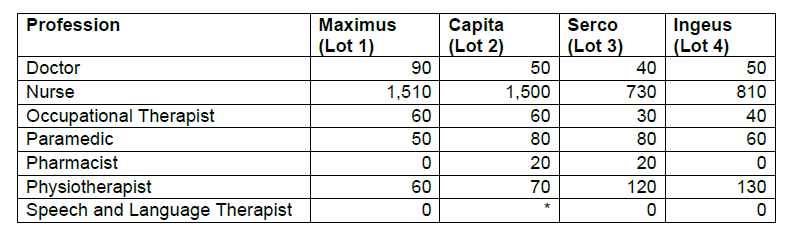
The table below gives the number of each type of health assessors employed by private contractors in October 2025.  Numbers have been rounded to the nearest 10 and an asterisk denotes fewer than ten – but more than zero.
hcp-professions.png

The table shows that the vast majority of assessors are nurses, though the DWP say that the companies do not tell them the proportion of different types of nurses, for example specialist mental health nurses, they employ.

But the figures make clear that both Capita and Serco employ around 20 pharmacists and that, in addition, Capita employ a very small number of speech and language therapists.

The figures do not say whether these staff are employed to carry out PIP assessments or WCAs or both.  But given that the report detailed above stated that paramedics were only employed to do PIP assessments, this may well be the case for pharmacists and speech therapists too.  (We are making further enquiries).

There is no doubt that both professions are registered healthcare professionals.  But then, according to the Health and Care Professions Council, so are:

  • Art therapists
  • Chiropodists
  • Dietitians
  • Hearing aid dispensers

As recruitment problems persist for the assessment companies, what is the likelihood that they will turn to some of these other, very narrowly specialised, professions for staff? 

There were almost 794,000 registered nurses in the UK at September 2025. The fact that assessment companies are having to turn to pharmacists and speech therapists to fill vacancies, says a great deal about the reputation and nature of the work these companies undertake.

And, for claimants being assessed by an increasingly wide, and not necessarily appropriate range of healthcare professionals, the PIP and WCA decision making process must seem ever more of a matter of chance rather than law.


Comments

Write comments...
or post as a guest
People in conversation:
Loading comment... The comment will be refreshed after 00:00.
  • Thank you for your comment. Comments are moderated before being published.
    · 1 hours ago
    Related to this thread, I have now had four occupational health assessments in the past year, none of whom have more than a basic medical background. My employers are not impressed. If the Government and employers want properly trained, medically qualified assessors, then they will have to cough up the money to employ them. Nothing ever comes out well doing it on the cheap.
  • Thank you for your comment. Comments are moderated before being published.
    · 1 hours ago
    I was speaking with a senior lecturer from my local university who teaches student nurses and she told me that because there is no guaranteed job for them when they qualify many go on to carry out PIP assessments as an alternative to being unemployed.
  • Thank you for your comment. Comments are moderated before being published.
    · 3 hours ago
    My local pharmacist always rolls her eyes at me when I have to tell her that I still get my prescriptions for free due to my benefit exemption, she's always rude to me and has that whole ''there's nothing wrong with you, pull yourself together'' vibe. She's the last person I'd want carrying out my assessment!
    • Thank you for your comment. Comments are moderated before being published.
      · 1 hours ago
      @TheLux She sounds very judgemental. I collect my medication from the machine outside using a code texted to me by the pharmacy or I could get it delivered if I choose.

      I'm based in Scotland so my medication is free also.

      I don't know if any of those two options are available to you though but it wouldn't do you any harm to enquire about it.

      It would save you the stress of dealing with the awful pharmacist. 
  • Thank you for your comment. Comments are moderated before being published.
    · 5 hours ago
    I used to work as a doctors receptionist, my friend has 25 years experience issuing prescriptions and querying doctors errors. My daughter has just passed her First Aid course....so there you go, we have filled three job roles as assessors. Well, left's face it we couldn't do any worse....
  • Thank you for your comment. Comments are moderated before being published.
    · 5 hours ago
    The wonders of the DWP and the greedy assessment companies working as  Sonderkommandos for their masters!
  • Thank you for your comment. Comments are moderated before being published.
    · 5 hours ago
    The problem is compounded by assessors relying on Condition Insight Reports. Which provide guidance for assessors on specific medical conditions and how they affect people.

    As reading the guidance on a condition I am familiar with does not instill confidence. As it omitted important information, especially about severe cases. Omitting many severe symptoms of the health condition, so giving a false impression of the illness. Omitting cases that are not able to be effectively managed by medication and are either always impaired or unstable, or where they have periods of months to years of hospitalisation and or are never able to live independently. Omitting permanent detrimental effects to health that can be caused, so giving a false impression of the risk and the need to award on the basis of substantial risk. Omitting side effects of mediation, including omitting side effects that can be permanent and impairing.

    So any assessor relying on the condition insight report would have a misleading impression of the health condition. Making them less likely to award the benefit and less likely to award higher levels or longer durations. And even risks the assessor wrongly thinking the claimant is exaggerating or making stuff up, as what they say is not what the expert guidance in the health condition insight report tells the assessor. 
  • Thank you for your comment. Comments are moderated before being published.
    · 5 hours ago
    I've always asked the qualifications of my assessors. It can give you a bit more ammo if you need to challenge the decision..
We use cookies

We use cookies on our website. Some of them are essential for the operation of the site, while others help us to improve this site and the user experience (tracking cookies). You can decide for yourself whether you want to allow cookies or not. Please note that if you reject them, you may not be able to use all the functionalities of the site.