

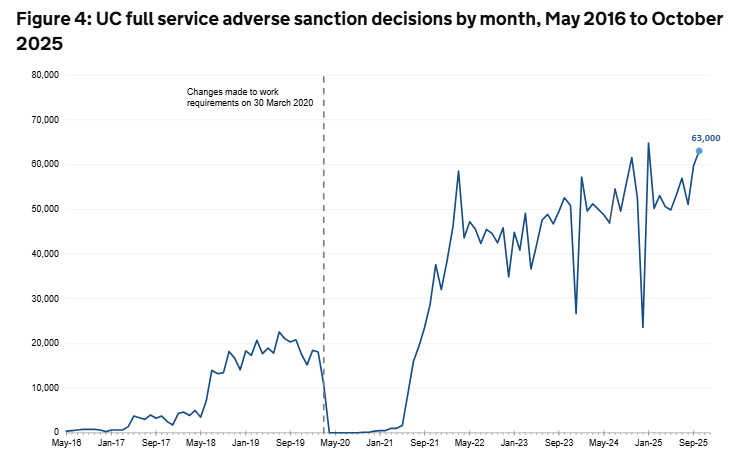
Universal credit (UC) sanction numbers have hit record highs since Labour took power, the latest figures released by the DWP reveal.

Before Labour took office, the highest number of monthly sanctions had been 57,276 in January 2024.

However, since Labour were elected, up to October 2025 – the latest month that figures are available for - sanctions have gone over the 60,000 mark on three occasions.

In October 2024 there were 61,601 adverse sanction decisions, in January 2025 there were 64,866 and in October 2025 there were 63,025.
uc-sanctions.png

90% of all sanctions are for failure to attend or participate in a mandatory interview and a further 5% are for failing to be available for work.

You can read the full sanctions statistics here.

Benefits and Work subscribers can download a copy of our 30 page guide to “Ways to Prevent and overturn ESA and UC sanctions” from the ESA and UC guides page

Comments

Write comments...
or post as a guest
People in conversation:
Loading comment... The comment will be refreshed after 00:00.
  • Thank you for your comment. Comments are moderated before being published.
    · 13 days ago
    There should be a rule that states that if somebody is severely disabled and lives alone i.e. does not have any family to help them financially/ in a crisis, their benefits should never be stopped. Mine were stopped for four months and I don’t even know how I’m still alive. 
  • Thank you for your comment. Comments are moderated before being published.
    · 13 days ago
    There will be a special place in hell for the architect of UC -Iain Duncan Smith , its the most unfair , punitive and heartless benefit concept that's ever been conceived 
  • Thank you for your comment. Comments are moderated before being published.
    · 15 days ago
    Ummmm back in the day if you didn’t turn up to sign on for unemployment benefit at the dole office you got nothing, ie no giro in the post. Signing on was every fortnight. The only way out of it was to get a Sick Note and post it to them. Yes, sometimes mistakes were made but people just got on with it. I’ve long thought we should bring back signing on. 
    • Thank you for your comment. Comments are moderated before being published.
      · 15 days ago
      @Ronyag The problem with having people turn up and sign on every fortnight is UC conditionality and sanctions regimes do not just apply to the able unemployed.

      People subject to UC conditionality and sanctions regimes include:
      Those who care for a child aged 1 or over.
      Those who care for a disabled person but for less than 35 hours a week.
      Those who have been assessed as effectively incapable of any and all paid employment due to illness or disability, but not assessed as incapable of any and all appropriate work related activities (even if the DWP work coach cannot think of any appropriate work related activities they could do).
      Those who are in paid employment but below the hours or minimum income threshold.

      So you would have to schedule DWP sign in appointments at the job centre around claimant's caring responsibilities and work commitments and for some disabled claimants the availability of a carer to take them to the job centre or support them at the job centre. And for some claimants you may need to do home visits due to the claimants disability making it difficult or impossible for them to attend the job centre.  

      Also there are less job centres today than there used to be so getting to the job centre maybe an issue.  
    • Thank you for your comment. Comments are moderated before being published.
      · 15 days ago
      @Ronyag I thought that Work coaches made an appointment too see you every two weeks to check on your job search if unemployed or in the old Wrag group.
  • Thank you for your comment. Comments are moderated before being published.
    · 19 days ago
    We should never forget that behind these statistics are real people who have suffered greatly because of benefit sanctions - see the analysis on this issue I wrote a while ago:

    Corroborating Evidence: The Deadly Impact of Benefit Sanctions
    The following three recent news articles and investigative reports corroborate the claims made regarding the deadly and harmful impact of the benefit sanctions regime on disabled people.
    1. The Inquest into the Death of Jodey Whiting (Rethink Mental Illness, June 2025)
    Key Corroboration: Direct link between DWP action and suicide.
    A second inquest into the death of Jodey Whiting, who took her own life in 2017, concluded in June 2025 that her death was precipitated by the Department for Work and Pensions withdrawing her benefits 1. Ms. Whiting, a disabled woman, had her benefits cut after failing to attend an appointment due to being seriously unwell and in hospital. The coroner's ruling directly establishes a causal link between the DWP's punitive application of sanctions and a claimant's death. The report highlights that despite years of campaigning, "harmful benefit sanctions and a punitive approach continue to this day, leading to the severe harm and deaths of people living with severe mental illness" 1.
    2. DWP Safeguarding Report by the Work and Pensions Committee (Big Issue, May 2025)
    Key Corroboration: Systemic failure and preventable deaths.
    A damning report, Safeguarding Vulnerable Claimants, released by the cross-party Work and Pensions Committee in May 2025, concluded that the deaths of benefit claimants “could have been prevented” by the DWP 2. The report slammed the DWP’s “deficient” safeguarding practices and called for a "deep-rooted, cultural change" within the department. It noted that the true scale of deaths and serious harm is unknown because the DWP fails to systematically record all cases. Committee chair Debbie Abrahams stated that the process of engaging with the DWP itself "too often led to mental distress," and where this led to a loss of financial support, "many had paid the ultimate price" 2. This report confirms the systemic nature of the DWP's failure to protect vulnerable claimants from harm, including that caused by sanctions.
    3. Investigative Report on DWP Cover-ups (Disability News Service, December 2024)
    Key Corroboration: Institutional cover-up of DWP-linked deaths.
    An investigative report published in December 2024 detailed how senior civil servants and ministers have spent more than a decade "covering up evidence that links the actions of a government department with hundreds, and probably thousands, of deaths of disabled people" 3. The report focuses on the DWP's practice of conducting secret 'peer reviews' into claimant deaths, which were never shared with the families of those who died. It cites cases where coroners have sent Prevention of Future Deaths (PFD) reports to the DWP, such as following the suicide of Michael O’Sullivan, whose death was triggered by being found fit for work. The report concludes that the DWP has "caused the deaths of hundreds, and probably thousands, of disabled people" and has persistently failed to make its assessment processes safe, directly linking the department's hostile culture and policies (including sanctions) to fatal outcomes 3.
    References
    [1] Rethink Mental Illness. We respond to second inquest into death of Jodey Whiting. June 3, 2025. [Source:
    [2] Cooke, Laura. DWP needs 'deep-rooted change' to stop benefit claimants' deaths, damning report finds. Big Issue. May 15, 2025. [Source:
    [3] Disability News Service. Deaths, lies and cover-ups: the case for a public inquiry into the ‘unthinkable cost’ of DWP’s systemic violence. December 20, 2024. [Source:
  • Thank you for your comment. Comments are moderated before being published.
    · 19 days ago
    I've seen lots of homeless getting sanctioned because they failed to answer a call because their phone had no charge.

    It's a cruel system and so many people are living off charity handouts because the DWP doesn't care. Even state pensions is now called a benefit.
    • Thank you for your comment. Comments are moderated before being published.
      · 13 days ago
      @John John, not so. State pension is contribution based and is deferred salary.
    • Thank you for your comment. Comments are moderated before being published.
      · 18 days ago
      @John Plus it makes up for 55% of welfare spending which the Tories/Reform would never dare talk about.
    • Thank you for your comment. Comments are moderated before being published.
      · 19 days ago
      @Ziggy State pension has always been a benefit. 
  • Thank you for your comment. Comments are moderated before being published.
    · 20 days ago
    The sole objective with UC is to reduce and stop benefit money.   "Tailored" Support is a lie as WFI seem to come with a script and Work Coaches do anything and everything to try and trap you and trick you into a sanction.   Nothing more than a " How can we sanction this claimant to get our bonus"  
  • Thank you for your comment. Comments are moderated before being published.
    · 20 days ago
    "UC sanction numbers hit record high under Labour". As a number yes, due to the increase in the number of people on UC and subject to the UC sanctions regime. But, not as a percentage of claimants who are on UC and subject to UC sanctions regimes who are under sanction.

    As a percentage of those subject to UC sanctions regimes the percentage under sanction is lower under Labour (latest figures 2025 November 5.9%) than the record high under the Tories (2017 January 11.8%) and lower than the same month in the last two years under the Tories (2022 November 6.9%, 2023 November 6.7%).

    Labour are sanctioning a lower percentage of claimants on UC and subject to UC sanctions regimes. 
    • Thank you for your comment. Comments are moderated before being published.
      · 16 days ago
      @John More compation please
    • Thank you for your comment. Comments are moderated before being published.
      · 18 days ago
      @John That does not make Labour's sanctions policy any less despicable for the harm it causing to large numbers of people.
We use cookies

We use cookies on our website. Some of them are essential for the operation of the site, while others help us to improve this site and the user experience (tracking cookies). You can decide for yourself whether you want to allow cookies or not. Please note that if you reject them, you may not be able to use all the functionalities of the site.