


Information obtained by Benefits and Work suggests that work capability assessment (WCA) reassessments will be at their height in 2031 and that over half of the £1.9 billion welfare savings set out in the last budget will come from assessment companies or DWP administrative costs, rather than claimants.
In the November 2025 budget document, the chancellor announced welfare savings from: “Health and Disability Benefits: Improve operations by increasing face-to-face assessments, increasing WCA reassessment capability, and PIP award review changes, starting from April 2026.”
Annual savings totalling £1.9 billion up to 2031 were then listed. But no further breakdown of how the savings would be made was given.
On 2 December 2025 we made a Freedom of Information (FoI) request to both the DWP and the Treasury for a breakdown of how the savings would happen.
On 19 December the DWP made public some further details, including that the proportion of face-to-face assessments for PIP and the WCA would increase to 30%. In addition, the time between PIP reviews for claimants aged 25 and over would be extended to a minimum of three years for a new claim and five years at the next successful review.
We then made a further, more detailed request to the DWP on 29 December.
In January 2026, the Disability News Service revealed that the DWP had refused to provide both them and the Liberal Democrats with any additional information on how the savings would be made.
Also in January, we received a response from the Treasury making the improbable claim that it would cost too much too answer our request, which we immediately challenged.
Given that the savings were now part of the economic forecast for the next five years, it seemed extraordinary that the DWP wouldn’t explain how they worked. Clearly there was something the government was reluctant to disclose.
Yesterday, late and after chasing, we finally received a substantive reply from the DWP
We had asked:
1 Please give a detailed breakdown of how the £1.9 billion is to be saved, including:
a) Any additional assessment costs created by increasing the number of WCA reassessments
b) Any savings resulting from a reduction in the number of claimants found to no longer have LCWRA due to the increased number of WCA reassessments
c) Any savings in assessment costs caused by extending the time between PIP reviews
d) Any additional assessment costs caused by increasing the proportion of PIP face-to-face assessments
e) Any savings in PIP costs caused by increasing the proportion of PIP face-to-face assessments, due to the lower success rate for PIP applicants when assessed face-to-face rather than remotely.
The DWP replied:
The £1.9bn comprises the following figures shown in Table 1:
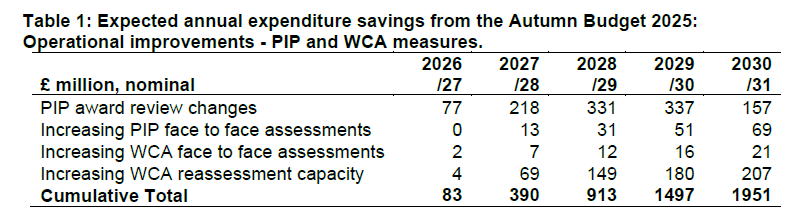
This £1.9bn figure does not include any additional assessment costs. This is because the reduced number of assessments for PIP releases resource to increase WCA reassessments and face-to-face assessments, and there is no assumed net increase in the number of health care professionals employed by DWP’s contracted providers as a result of these policies.
What the figures appear to show is that, over the next five years, £1.12 billion of the savings, 57%, will come from reducing the number of PIP award reviews. This may come from reduced payments to the assessment providers and/or reduced administrative costs for the DWP.
A further £609 million, 31%, will come from increasing the number of WCA reassessments. This saving presumably comes from removing the UC health element (LCWRA) from more claimants. At the moment there is a massive backlog of both WCAs and WCA reassessments and it appears to be growing.
A recent FoI request by Rightsnet revealed that there are currently 78,000 queued WCA reassessments, with the DWP generally managing to carry out fewer than 4,000 per month. This is in addition to 280,000 initial WCAs, which the DWP are getting through at well under 50,000 a month.
A further £164 million of the savings above, 8% , will be the result of having a higher proportion of PIP face-to-face assessments, where the refusal rate is higher than for telephone assessments.
And £58 million, 3%, will be due to more WCA face-to-face assessments.
There are two striking things about these figures, if we are understanding the scant information correctly.
The first is that almost 60% of the money saved is not being taken from claimants, something that was not made clear in the government announcements on these measures.
The second is that in 2030/2031 WCA reassessments will be still be taking place and will in fact be making savings at the greatest rate of the five year period. Yet, according to the Pathways To Work Green paper, the WCA should have been abolished by 2028/29 with access to the UC health element decided by eligibility for the PIP daily living component.
So, in spite of McFadden’s insistence that the WCA is still to be abolished, there now seems less likelihood that it will happen in this parliament.
And who knows who will be running the DWP in the next one?